The Story Behind the Name ‘Expanish’
Trust us, we've heard the questions. How do you say Expanish and what does it really mean? So what's with the name? Check out this article from one of our founders, Agustín Vignale, to learn the story behind our name.

Twenty years ago, Alejandro and I drove to the airport in Buenos Aires to pick up a stranger.
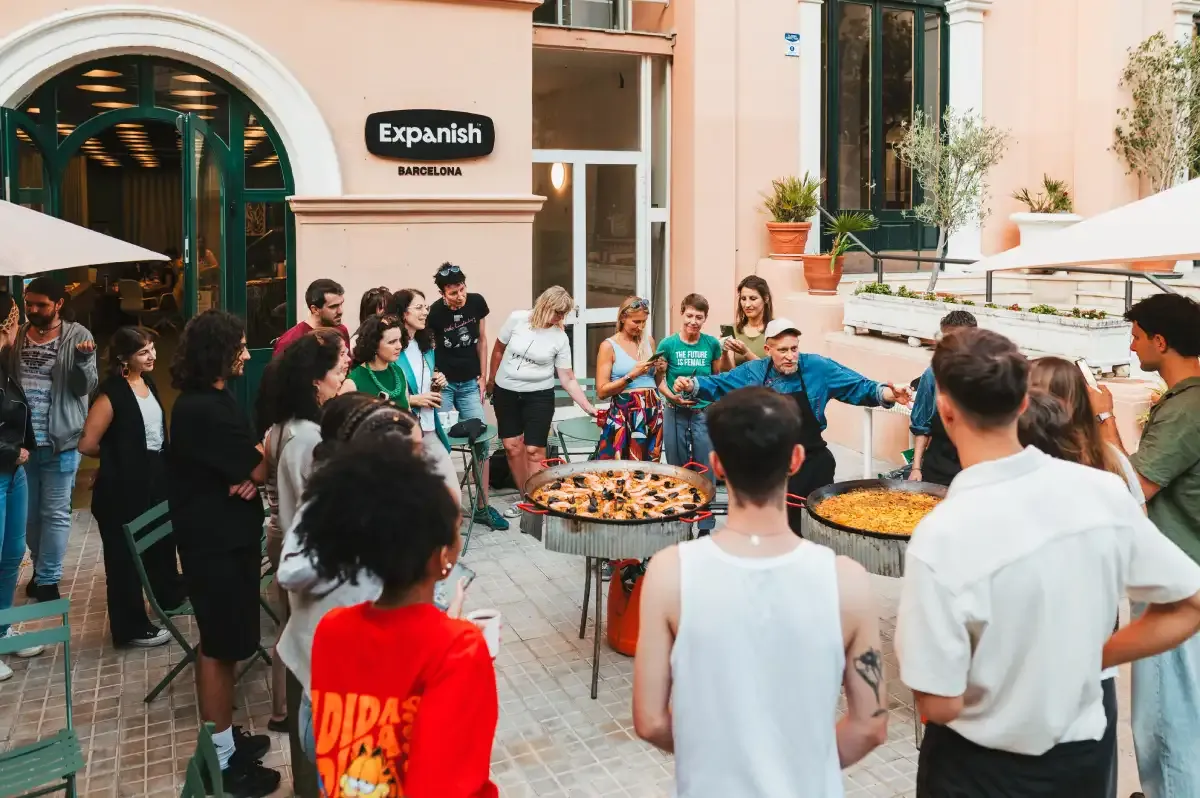
His name was Ben, and he was our very first student. We did not send a taxi or a generic welcome email with a map attached. We went ourselves. We waited at arrivals with his name written on a piece of paper, shook his hand, helped him with his bags, and drove him into the city while pointing out everything along the way.
Ben stayed for a few months. In that time he played fútbol with us on weekends, showed up to our asados, came out with our friends, and somewhere along the way he stopped being “our first student” and became one of ours. Two decades later, that feeling — of transformation, connection and belonging — is still the whole point of Expanish.
A Name That Is Really a Promise
The name itself is simple: Experience + Spanish = Expanish.
But the word that has always mattered most to us is not “Spanish.” It is “experience.” When Alejandro and I started out, we did not want to build just another study center. We wanted to give people something they could live, not just learn.
I will be the first to admit that Expanish is probably not a perfect brand name. It is not always obvious how to say it, and people do not always know how to spell it. We spent a long time on this at the start, sending out surveys, going back and forth, second-guessing ourselves. But here is what twenty years have taught us: a brand is not built in a naming study. It is built in real life. A brand becomes the reflection of the culture that its people forge together, day by day. By that measure, Expanish is no longer just a clever word to us; it has become a synonym for living a transformative experience abroad.
More Than a Language Program
It took us years to be able to say this out loud, even though we felt it from the very first day. What we facilitate is not just a language course. It is an immersion program, a way to live abroad and be welcomed into a place rather than simply pass through it.
What began with Ben in Buenos Aires now spans immersion programs across Argentina, Spain, and Costa Rica. The local language and culture is part of every one of them, of course. It is how you get in the door, order a coffee, argue about fútbol, and finally understand the joke at the dinner table. But it has always been about much more than language. What really changes you is everything that happens once you are through that door. The host families, the friendships, the ordinary days spent figuring out a culture from the inside.
And it does not matter whether someone stays two weeks, two months, or a full year. The transformation happens. Students arrive a little timid, unsure of what they have signed up for, and they leave having experienced a kind of personal growth they did not know was possible. Their view of the world, and of themselves, never quite goes back to what it was.
What We Are Really Building
If I had to put our purpose into a few words, it would be this: we create understanding through cultural immersion.
We did not invent that idea, and we are in good company holding it. Eighty years ago, the founders of UNESCO opened their charter with a line I have never forgotten: "since wars begin in the minds of men, it is in the minds of men that the defences of peace must be constructed." Their argument was simple: ignorance of how other people live breeds suspicion, and the cure is mutual understanding. That may sound like a heavy thing to pin on a dinner table in Buenos Aires, but the instinct is the same, scaled to each student we impact. People who have shared a meal, a language, and a few months of real life together rarely go back to seeing each other as strangers.
The Most Human Thing We Do
I think about this more and more lately. The world is moving at remarkable speed towards digitalisation and artificial intelligence. Almost everything we do now — our work, our friendships, the most ordinary parts of daily life — is via a screen. That is exactly why I believe what we do matters more than ever: we do it offline.
And this is not just a feeling. Public health officials now describe loneliness as an epidemic, and warn that social isolation can be as harmful to our health as a daily smoking habit. At the same time, the skills the working world says it values most are no longer the ones you can memorize, but the human ones, adaptability, curiosity, resilience, the ability to connect across differences. You do not build those behind a screen. You build them by getting on a plane, sitting at an unfamiliar table, and figuring life out somewhere new.
What Twenty Years Has Taught Us
Over two decades, well over a hundred thousand people have passed through our programs. To this day I meet former students, often before I can place them, who tell me with real sincerity how these months abroad changed the direction of their lives. None of them describe it as a trip. They describe it as a turning point.
That is the part I find myself reflecting on most. Studying abroad is not tourism with homework. It is one of the few experiences that reliably changes how a person sees the world, and it tends to do its work quietly, planting something that keeps growing long after the flight home.
So whether you are a student weighing up a two-week program or a full semester somewhere unfamiliar, or someone who helps students make that choice, I will not try to sell you anything. I will just share what twenty years of watching people arrive and leave has convinced me of: in a world that keeps pulling us further behind our screens, the time spent living inside another culture may be among the most valuable a person can give themselves. That, far more than any name, is what Expanish was always meant to be about.
Founded in 2006 by Agustín Vignale and Alejandro Rched in Buenos Aires, Expanish began with a simple mission: to create meaningful language and cultural immersion experiences for international students. Today, Agustín and Alejandro continue to lead the organization as co-directors, overseeing operations across six destinations in Argentina, Spain, and Costa Rica.