How to Learn Spanish Fast: 10 Evidence-Backed Methods That Work
Learning Spanish doesn't have to take years. While genuine fluency is a long-term project, there are evidence-backed strategies that can accelerate your progress and get you to a conversational level in the quickest time possible.


There is no one-size-fits-all approach to learning Spanish, and no universal timeframe for becoming fluent. Different people find that different strategies and methods may work best for them, and often the best results usually come from combining several techniques rather than relying on a single rule. But here are 10 methods that have been shown to help language learners advance quickly.
Seek Full Immersion
Take an Intensive Spanish Course
Prioritise Speaking From Day One
Lose the Fear of Mistakes
Surround Yourself With Spanish
Use Spaced Repetition for Vocabulary
Learn High-Frequency Words First
Practice Shadowing for Pronunciation
Set Concrete, Measurable Goals
Consistency Beats Sporadic Intensity
Let's look at each one in a little more detail.
1. Seek Full Immersion
If you are able to spend an extended period in a Spanish-speaking environment, do it. There is really no better way to make quick progress that to be fully immersed in the language.
Living abroad gives you endless opportunities to hear and use Spanish in practical, everyday situations. Whether ordering food, chatting with neighbors or handling errands, navigating day-to-day interactions in Spanish is a great way to build confidence experience the language being used in the real world.
And when Spanish is all around you, practicing becomes easy. That said, you still have to make the effort to get the results: spending months abroad but mostly socializing in English is very different experience than getting out of your comfort zone and actively using Spanish every day.
2. Take an Intensive Spanish Course
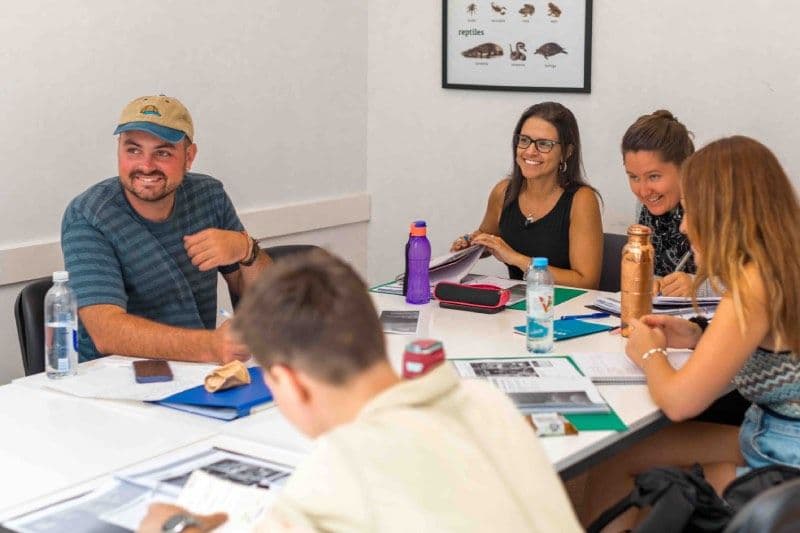
Self-study can take you a long way, but it can't compare with structured learning every day, ideally with a native Spanish speaker. This is partly because it will push you to study and practice the language on a daily basis — it should be obvious, but putting in more hours will usually help you advance faster. For example, taking an intensive Spanish language course with Expanish means daily lessons and around 20-30 study hours per week with highly-qualified, native teachers. Combine this with the full immersion you get in a Spanish-speaking country (see above) and you will be amazed at how quickly you progress.
Additionally, feedback from an expert becomes increasingly valuable as you start producing more Spanish. A good teacher can identify your strengths and weaknesses, helping you to iron out grammatical errors, pronunciation problems and unnatural phrasing. They can also adapt exercises to prioritize your needs and give you opportunities to use new language correctly while providing real-time support.
Method | Speed | Structure | Best For | Est. Time to Conversational Fluency (B1/B2) |
Self-study | Slow | None — self-directed | Absolute beginners on a tight budget | 3+ years without structured feedback |
Apps | Slow–Moderate | Light, gamified | Building vocabulary habits | Around 1-2 years |
School (part-time classes) | Moderate | High — regular feedback | Correcting mistakes, structured progress | 12–18 months |
Full immersion with intensive Spanish course (studying abroad) | Fastest | Very high — expert feedback and continuous support | Rapid, real-world fluency | 4-6 months |
3. Prioritise Speaking From Day One
Don't wait until your Spanish is "good enough" before you start speaking.
Speaking in Spanish forces you to retrieve words and integrate grammar in real-time. Research shows that this sort of deep cognitive processing helps accelerate learning. Talking aloud will also help you find gaps in your vocabulary, or identify words/sentences that you find challenging to structure or pronounce. This in turn will allow you to adapt your future learning to tackle problem areas.
At Expanish, we have found that a communicative approach is the best way to help students at all levels feel more comfortable and confident using the language in a supportive environment. It also means that students learn by talking about Spanish culture, current affairs, sports, dance, art, human rights, and business, providing valuable context and meaning to language acquisition. Our free student activities provide another space for students to practice the Spanish they learned in class in a fun and relaxed social setting with other like-minded people.
Outside of school, you can seek a conversation partner or join a language exchange group. It's not about being able to speak in perfect sentences right away — no-one expects that. It's about giving yourself the opportunity to produce the language in your own voice, notice what you can't yet say, and try again.
4. Lose the Fear of Mistakes
Seeking perfectionism can really slow your language learning. The fear of making a mistake is one of the biggest hurdles that language learners have to overcome, especially beginners.
But mistakes are actually a crucial part of the learning process. They show you where your current knowledge ends and where you need more practice or feedback.
Also, once you get out and start using the language in real-life situations, you'll realize that being able to communicate effectively in Spanish — being understood and being able to express yourself — is more important than grammatical perfection. Do this as much as possible and, over time, you will naturally get better at noticing your own mistakes, correcting them, and gradually stop repeating them.

5. Surround Yourself With Spanish
Though it is the best way to accelerate learning, you can create your own immersive learning environment without moving to Spain or Latin America.
You can watch Spanish-language programs (put Spanish subtitles on to help you follow), or listen to Spanish radio or podcasts while commuting, cooking or exercising. Start reading Spanish-language newspapers, magazines or books - picking something that covers a subject you already know a lot about will help your understanding. If you want to practice using the language yourself, trying switching your phone or keyboard into Spanish so you can start using special characters and accents while writing.
This approach lines up with linguist Stephen Krashen's influential Input Hypothesis, developed in the 1980s. The core hypothesis is that, rather than memorizing grammar rules, we acquire a second language more naturally and effectively if we are exposed to meaningful Spanish content that is just slightly beyond our current proficiency level.
Of course, the emphasis here is on "inputs" only — listening and reading in Spanish. However, this should complement active "interaction" (speaking and receiving feedback) and "outputs" (writing) for the most effective language learning experience.
6. Use Spaced Repetition for Vocabulary
Spaced repetition is a popular study technique that aims to improve long-term memory retention. The basic idea is that you have repeated encounters with words over increasing time intervals. So, instead of trying to memorise individual words or a paragraph by reading them over and over again in one study session (ahem, like cramming the night before an exam), you space this process out with shorter study sessions split over several days. As you become more familiar with the words you can increase the time in between practice sessions, and eventually they will be fixed in your long-term memory.
Using flashcards or flashcard apps like Anki can make this process much more efficient by prioritising vocabulary that you're more likely to forget. Remember that, as with the Input Hypothesis, this technique should be just one part of your language learning and complement your speaking. It will work best if used alongside other methods that focus on reading, listening and actually using the words in context.
7. Learn High-Frequency Words First
Not all vocabulary is equally useful.
Learning common words and phrases gives you more immediate payoff than working randomly through a dictionary. Frequency-based learning can therefore be a sensible way to prioritize vocabulary, particularly for beginners. In simple terms, learn the words you're most likely to encounter first, and learn them in useful phrases and sentences rather than as isolated translations.
8. Practice Shadowing for Pronunciation
Shadowing is another language-learning technique that involves listening to a native speaker and repeating what they say with little or no delay, attempting to mimic their rhythm, stress and intonation. This works best with a relatively short bit of audio. The aim is to capture the natural flow, melody, and cadence of the native speaker rather than getting bogged down on each syllable or sound.
9. Set Concrete, Measurable Goals
"Getting better at Spanish" is a vague and abstract objective, which can sometimes make it harder to stay on track. Setting our clear and attainable objectives can help keep you motivated and give your study direction, which will support effective language learning.
Some people find it helps to break down language learning into specific targets. Examples could include:
Master 12 useful phrases to navigate an upcoming trip
Have three 10-minute conversations in Spanish each week
Understand the main idea of a five-minute Spanish podcast
Read and understand a Spanish language novel
Concrete goals make progress easier to see, and can help you focus on the particular language skill you care about most, either because it is what you find challenging or if it will be the most useful for you given your circumstances.
10. Consistency Beats Sporadic Intensity
A regular study routine is generally more useful than intense periods of cramming followed by long breaks.
Research on distributed practice supports spreading learning across multiple sessions rather than concentrating everything into a single block, although the optimal spacing depends on the learner, task and material.
That doesn't mean every session has to be long. Twenty focused minutes that you can sustain most days may be more useful for your long-term progress than an ambitious three-hour session that leaves you exhausted and unlikely to study again for a week.
The key is to build a routine you can actually maintain.
Bottom Line
There is no single shortcut to Spanish fluency, but following these tried and tested methods usually leads to fast and effective progress.
Often, the best approach is to combine several of the tips above, seeing which ones work best for you and how combine several approaches for maximum impact.
Ultimately, nothing beat genuine immersion. Spend several weeks or months surrounded by Spanish speakers daily and you will see real gains, especially if you're actively engaging with the language. Add in an intensive course with a reputable institution, and you've got the best chance to get fluent fast.
For total immersion in dynamic city destinations in Spain, Argentina or Costa Rica, check out our Spanish programs.