DELE and SIELE: Which Spanish Exam Should You Take & How To Prepare (2027)
If you want to accredit your Spanish level for personal or professional reasons, you will likely need to take one of two official exams: DELE and SIELE. But what are the differences between them, and which should you choose? This guide gives you all the key information and tips to help you prepare.


The DELE and SIELE are Spanish proficiency exams that are both backed by the Cervantes Institute, the official state institution for promoting the Spanish language. Both exams are aligned with the standardised levels (A1 to C2) in the Common European Framework of Reference for Languages (CEFR). However, the exams work differently and have different uses and purposes, so it’s important to know which is most suitable for your situation.
In this guide we will examine:
The key facts and differences between the DELE and SIELE proficiency tests
How to decide whether to take the DELE or SIELE exams
What taking the DELE and SIELE tests involves - formats, levels, costs, dates
How to apply for the DELE and SIELE exams
How you should prepare for the exams
What are the DELE and SIELE Exams?
Both exams certify your Spanish language ability by assessing the core skills of reading, listening, writing and speaking.
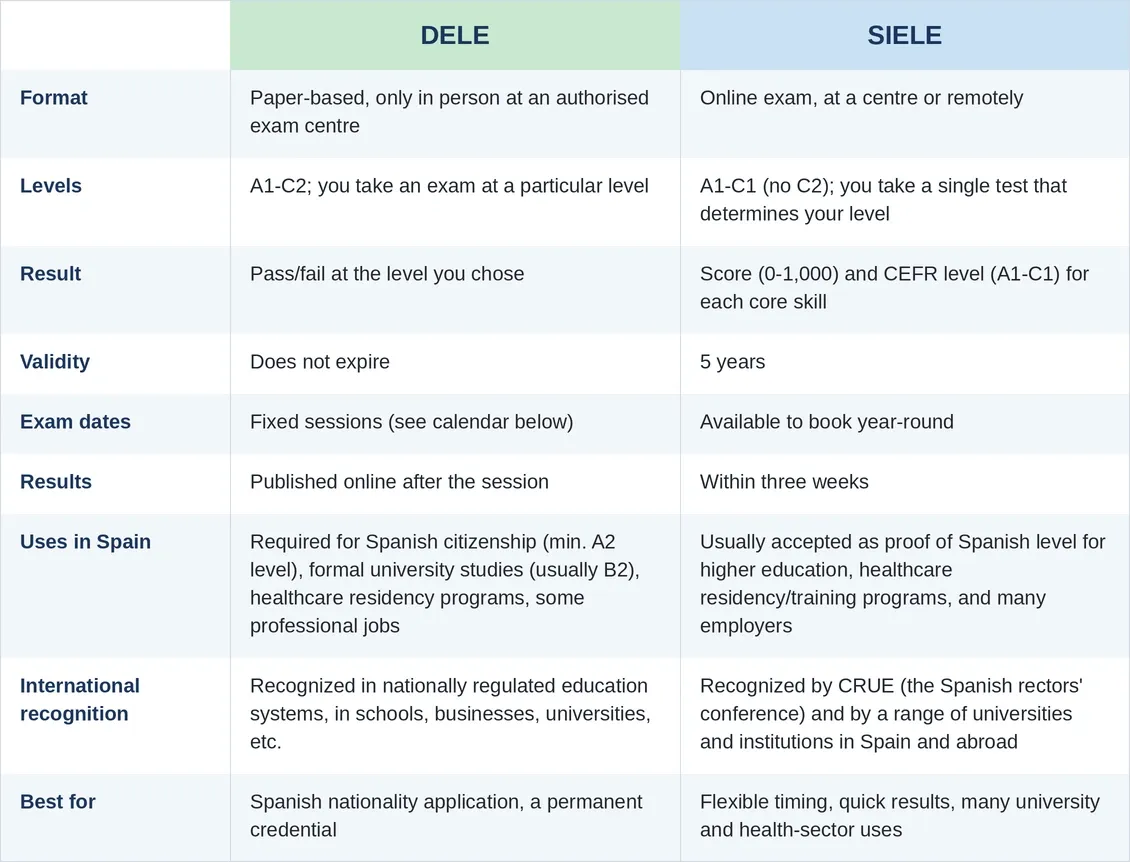
DELE (Diplomas de Español como Lengua Extranjera) is the official Spanish diploma awarded by the Instituto Cervantes on behalf of Spain's Ministry of Education. You choose one of six CEFR levels, A1 to C2, and sit the exam for that level. The result is pass or fail, and the diploma, once awarded, does not expire.
SIELE (Servicio Internacional de Evaluación de la Lengua Española) is a digital exam created by the Instituto Cervantes, the University of Salamanca, UNAM in Mexico and the University of Buenos Aires. It is a single multilevel exam, so you don't choose a level in advance but will be awarded a level based on your score. You can take a “global” SIELE exam that tests all four core language skills, or choose independent modules that only test certain core skills. For each skill, you will receive a score from 0-250 (added up to 1,000 in the global exam) and a CEFR level, from A1 to C1. You cannot fail it, because you always get a result. Once you obtain a certificate it is valid for five years.
What Are the Main Differences Between DELE and SIELE Exams?
Which Spanish Proficiency Test Is Right For You: DELE or SIELE?
The answer depends on what you need the certificate for.
Choose DELE if:
- You are applying for Spanish nationality by residence.
- You want an official credential that never expires.
- You want to achieve a certificate at the C2 level.
Choose SIELE if:
- You need a certificate quickly, or can't wait for a fixed session
- You aren't sure of your current level.
- You only need to test certain core Spanish skills (reading, writing, listening, or speaking)
TIP: Immigration, visa and nationality rules can change. If you need to certify your Spanish for an official procedure, always confirm the current language requirements with the relevant government authority before booking an exam.
DELE Levels, Qualifications and Fees for 2027
Level | CEFR descriptor | Typical use | Fee in Spain* |
A1 | Beginner | First official proof of basic Spanish | €112 |
A2 | Elementary | Level required for Spanish nationality by residence | €138 |
B1 | Intermediate | Everyday independence; the minimum required for some academic courses and jobs | €173 |
B2 | Upper intermediate | This is the level most commonly required for university study and professional roles in Spanish-speaking countries | €204 |
C1 | Advanced | Required for demanding academic and professional settings, such as teaching Spanish or postgraduate study | €225 |
C2 | Mastery | Near-native command, often only required for specific professional roles such as translation or interpretation | €240 |
*Fees are based on the official DELE price table for exams taken within Spain (2026 prices). Prices may vary outside of Spain, depending on which country or city you take the exam in. The price of each exam is shown during the online registration, so check it carefully before you pay.
SIELE Modalities and Fees for 2027
The SIELE Global exam is made up of four tests covering all four core skills, and is required for the full certificate. The independent modalities give you a SIELE report covering only the skills you sat, which is useful if you need to certify just one or two specific competencies.
Modality | What it covers | Fee |
SIELE Global | All four skills (full certificate) | €155 |
S1 | Reading + listening | €55 |
S2 | Reading + writing | €75 |
S3 | Listening + speaking | €100 |
S4 | Speaking only | €75 |
S5 | Writing + speaking | €100 |
*Fees are based on 2026 figures from siele.org.

DELE Exam Dates in 2027
DELE is offered in fixed sessions, and registration closes several weeks before each one. Not every level is offered in every session, so check the details below.
Session | Written exam date | Levels offered (adult/general) | Registration closes |
February | 12 Feb | A2 | 7 Jan |
April | 2 Apr | A1, A2, B1, B2, C1 | 10 Feb |
May | 22 May | A1, A2, B1, B2, C1, C2 | 7 Apr |
July | 9 Jul | A2, B1, B2, C1 | 12 May |
September | 10 Sep | A2 | 14 Jul |
October | 15 Oct | A2, B1, B2 | 1 Sep |
November | 13 Nov | A1, B1, B2, C1, C2 | 29 Sep |
The oral exam can take place on a different day from the written papers, so check your confirmation email for your slot.
Where Can You Take the Exams in Spain?
DELE exams can only be taken in person at Instituto Cervantes centers or at a network of authorized exam centers, which includes universities and some language schools. Not every center runs every session or level, so check exactly what is available around you. The interactive map on the Instituto Cervantes exam portal shows which centers offer your level on your chosen date.
SIELE is offered at authorized centers in Spain, including universities and language schools like Expanish! The "encuentra tu centro" search on siele.org provides a list of in-person options. You can also take the exam remotely from your home or workplace. In this scenario, you must comply with certain technical and environmental requirements (e.g. install official SIELE browser, photo ID verification, live video call to ensure environment is suitable, camera on throughout exam etc). You will be supervised in real-time during the exam.
Expanish is an official SIELE Center! You prepare with a customized intensive course and then take the exam in the same place.
How To Apply
DELE
Within Spain
Register as a candidate on the Instituto Cervantes exam portal
Choose your centre, level and session, and check the registration deadline for that session.
Pay online by card. If you cancel, you have 14 calendar days from registration to request a refund.
Check your email. Your exam centre and the Instituto Cervantes will send your oral exam time and instructions.
Bring your original ID on exam day. If you are taking the A2 for nationality, register with your NIE and bring your original TIE (Foreigner’s Identity Card) and passport.
Outside of Spain
If you are overseas you must register at the official testing center
Submit a completed enrollment form and copies of your official ID (make sure the details match exactly)
The center will send details for how to pay.
Once payment is confirmed you will receive your registration and instructions about the exam day
Take your original photo ID and registration to the center on exam day.
SIELE
Go to siele.org and select "Reserva tu examen".
Choose your country, then "in a centre" or "remote". Pick your modality (global exam or individual modalities), date and time.
Pay online to confirm the booking.
If you take it at a center: arrive at least 15 minutes early and take the ID you booked with.
If you take it remotely: install the SIELE browser at least 24 hours before, have your ID and three photos of your face ready, and complete the environment check 30 minutes before the exam.
Download your certificate from your SIELE account within three weeks.
How To Prepare: Why an Intensive Course Helps
For both the DELE and SIELE exams you will benefit by preparing for the specific exam format as much as sharpening your general language knowledge. Being able to speak Spanish informally does not guarantee a good result if you are not familiar with types of questions asked, or if you don’t practise writing in Spanish within a set time period, or don’t get to grips with the speaking requirements in the exams.
For most candidates, the biggest gain comes from structured, supervised practice, which is where an intensive preparatory course at an accredited institution like Expanish pays off. A good course should include:
A placement assessment to find your current level and the gap to your target.
Exam-format training covering each task type and how it is marked.
Timed mock exams under realistic conditions.
Speaking practice with teacher feedback, which is the hardest skill to improve alone.
Targeted writing exercises and detailed feedback that includes what to fix and why.
At Expanish, our intensive exam preparation courses in Spain (Madrid, Barcelona, Málaga) or Argentina (Buenos Aires) are tailored to your needs and focused on exam-specific coaching from expert instructors. Taking the exam preparation courses in Spain or Argentina also means full immersion in the language, which means you can sharpen your skills in daily interactions with locals. Contact Expanish to discuss the right course length for your level and exam date.
Skill-by-Skill Preparation Tips
Reading: Practise with a timer, and learn to find the answer in the text rather than reading every word.
Listening: Listen to a range of speakers and accents. SIELE in particular was developed by institutions in Spain, Mexico and Argentina, and is specifically designed to incorporate different variations of Spanish, so varied listening is recommended.
Writing: Practise the formats and length limits of your exam, then get your texts corrected by a professional Spanish teacher during an exam preparation course.
Speaking: Say your answers aloud and record yourself, especially for SIELE, where responses are recorded.
In all cases, there are lots of mock DELE and SIELE exams available online. We recommend you complete at least a few of these - in exam-like conditions at least once - to get a good feel of the exam format and the types of questions that regularly feature.