Gap Year in Spain: Everything You Need to Plan the Perfect Year Abroad
In this guide we'll cover some of the practicalities and tips that will help you get the most out of your gap year in Spain. Things like the type of visa you might need, how to budget your trip, ideas for where to stay and travel, and why taking an immersive course with a local language school is one of the best ways to take the experience to the next level.


Spain is a place that really rewards slow travel, where you can really experience its rare combination of world-class cities, affordable lifestyle, great food, and welcoming climate. This is what makes a gap year in Spain such an interesting proposition – you can explore the country's beautiful cities and landscapes, get fluent in Spanish, build an international network of friends, and live well like a local on a budget that would barely cover rent in major US cities like New York or San Francisco.
CONTENTS
Why Spain?
Your Visa Options
Choosing Your Base City
How To Budget Your Gap Year in Spain
Anchor Your Gap Year with Expanish
Why Spain?
Perhaps a better way to frame this question is "why not?". Spain is a country that has so much to offer while being safe, welcoming and affordable for international visitors. A longer-term stay like a gap year gives you the opportunity to really experience the country like a local, exploring different regions, diving into the local culture and immersing yourself in the Spanish language. There really is no better way to get fluent quickly.
Then there's the lifestyle. Spain has a gentle pace of life that is hard to find elsewhere in Western Europe and sometimes hard for people to grasp. It's grounded in deep social connections and the enjoyment of simple pleasures like long lunches with family, evening walks and late-night parties with friends. That is not to say that Spaniards don't work or study hard — they do — but they don't forget the importance of a healthy work-life balance.
For students coming from high-pressure academic environments, it can be an eye-opening experience, one that broadens your perspective on life. And practically speaking, Spain remains one of the more affordable destinations in Western Europe for day-to-day costs, particularly compared to France, the UK, or the Netherlands.
Understanding Your Visa Options
Your visa situation depends heavily on what you plan to do in Spain, and the rules are specific so it's important to plan ahead and get it right. Remember, citizens from many non-EU countries, including the US, Canada, and UK, don't need a visa for stays up to 90 days in any 180 day period, where you are able to study or volunteer. Beyond 90 days, a visa is almost always required.
The information below is a quick summary of official visa categories that you could apply for to go on a gap year in Spain. However, you should always verify current requirements directly with the Spanish Consulate in your home country before applying.
Student VisaA common option for those interested in a gap year in Spain based around a study program (including Spanish courses at an accredited school like Expanish) | For stays over 90 days linked to enrollment in a recognised educational program, such as a university degree or a language course. You must apply for this at the Spanish Consulate in your home country at least 2 months before the start of your study program. You'll need proof of enrollment in a study program, financial means (around €600/months in 2026), and health insurance (minimum coverage of €30,000). Read our full guide to getting a study visa |
Digital Nomad VisaA good option if you already have a remote job or freelance income. It can be paired with a language course while in Spain. | Spain introduced a specific Digital Nomad Visa for remote workers in 2023, allowing stays of up to one year (renewable up to five years). Requires proof of remote employment or self-employment qualifications and income above a minimum threshold (200% of the gross national minimum wage, or around €2860 in 2026). Only 20% of income can be from a Spain-based company. Read more: How To Be a Digital Nomad in Spain |
Non-Lucrative VisaLess commonly used for gap years, but it is an option if you're about to self-fund and are not planning to earn income during your stay. | This is an option for those who wish to reside in Spain without permission to work. Requires comprehensive health insurance, criminal background check and demonstrating sufficient financial means (€2400 a month as of 2026). |

Choosing Your Base City
One of Spain's great advantages for gap year students is the variety of cities. You can choose to live out your own beachside fantasy on the Mediterranean coast, explore the northern region known as "green Spain", or experience the quintessential European cosmopolitan lifestyle of Madrid.
In fact, the best thing about a gap year in Spain is that could can experience a bit of everything. This could be spending several months in a larger city and then relocating to somewhere smaller and more relaxed (maybe up in the mountains, or by the beach?). Either way, it's really easy to move around Spain - and indeed Europe - so from your home base it will be easy to travel and explore during a longer stay.
Here's how some of our favourite Spanish cities compare:
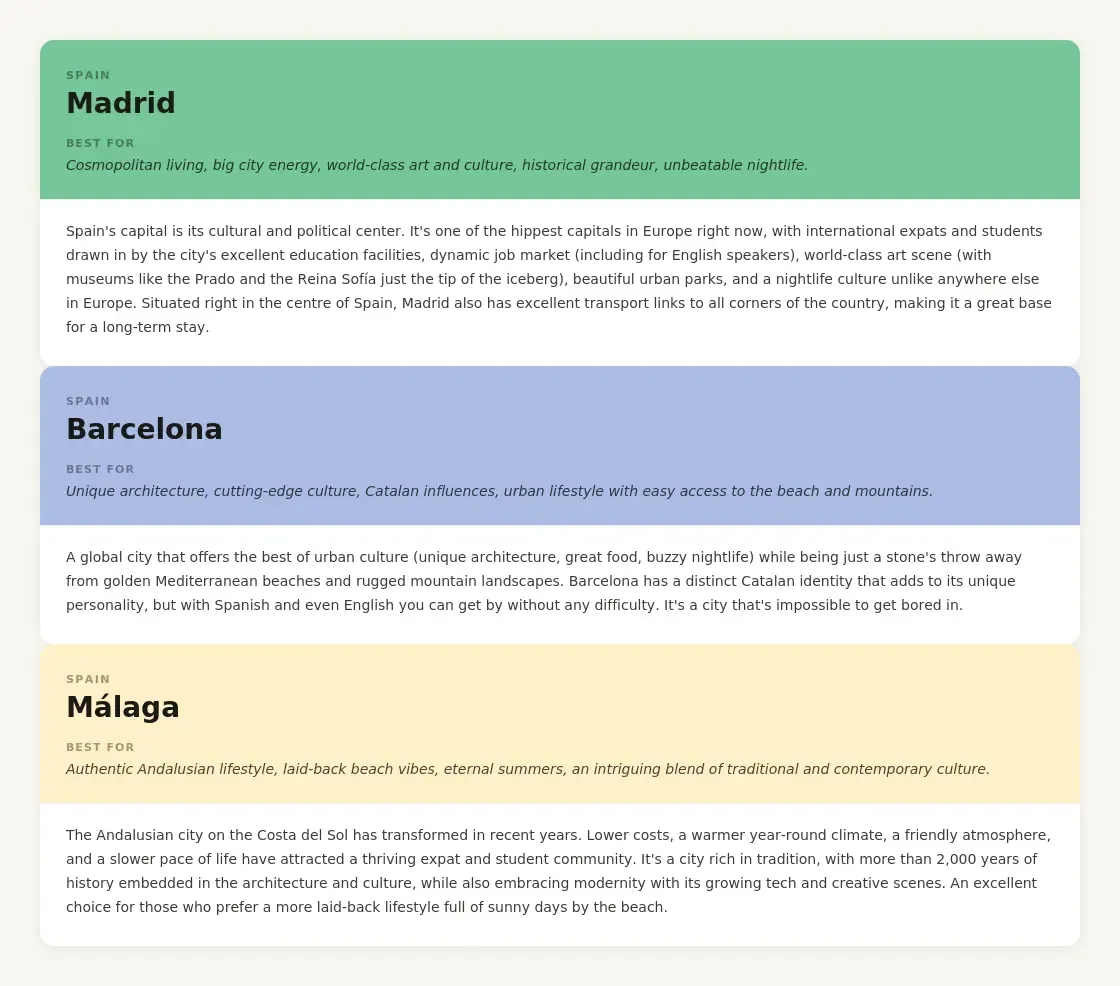
The beauty of a longer stay is that you can adopt a "mix and match" approach — spending a few months in one city, then relocating. This is increasingly popular for longer-term study abroad programs and logistically straightforward in Spain. The country’s high-speed rail network is affordable and connects major cities quickly: Madrid to Málaga is under two and a half hours, Madrid to Barcelona about two and a half. This also makes weekend travel easy throughout the year, giving you the opportunity for numerous short getaways.
What Does a Gap Year in Spain Actually Cost?
Spain is still genuinely affordable by Western European standards, but the range is wide depending on which city you choose and how you live.
The figures below are monthly estimates for an "average" student budget (not a luxury lifestyle, but not rock-bottom) as of 2026, and are based on comparison cost-of-living sites and some reported costs from students and programs operating in Spain. Of course, it would be easy to spend more if your budget allows it.
Category | Madrid / Barcelona | Málaga |
Shared apartment rent | €600–€900 | €450–€700 |
Groceries & cooking at home | €200–€300 | €180–€250 |
Eating out (casual, local) | €150–€200 | €120–€150 |
Public transport (monthly pass) | €20–€50 | €20–€30 |
Gym membership | €30-€60 | €30–€40 |
Social activities & leisure | €100–€200 | €80–€160 |
Phone (SIM + data) | €15–€30 | €10–€20 |
Estimated monthly total | €1,200–€1,750 | €900–€1,400 |

Anchor Your Gap Year With Expanish
A gap year in Spain can be a genuinely transformative experience. But let's be honest, arriving in a foreign country with no plan and no structure can be daunting, especially in the early days when you have to get to grips with the bureaucracy, build up a social network, find your way around the city, and learn all the "hidden" tricks to avoid tourist-trap routine.
This is where an immersive language centre like Expanish can really help. Enrolling in an intensive Spanish program gives you a daily schedule, a built-in cohort of fellow international students, and local staff who have helped thousands of students navigate exactly what you're going through.
It's a great way to start your gap year on the front foot, immersing yourself in your new home and improving your Spanish quickly with methods that are designed for real-world use. Being able to communicate in Spanish will be invaluable for your gap year in Spain, opening up doors to new opportunities, experiences and friendships. Even you arrive with zero Spanish skills, most students can reach a level of basic communication in a few months with an intensive course, and even achieve conversational fluency over 6-9 months.
Read more: How Long Does It Take To Speak Spanish Fluently
Just as important, Expanish's social events and cultural activities (free for our students) give you an instant social life in Spain and an education in local traditions and rituals. This is especially beneficial during the disorienting first weeks, when you're finding your feet in a new city. Our staff are local and know which neighborhoods to live in, which bureaucratic steps to follow for your residency registration, and which local experiences are worth having.
Think of the language school as the infrastructure of your gap year. Around it, you build everything else: weekend travel, local friendships, work or volunteer activities, and the spontaneous getaways that makes living abroad genuinely different from a short-term travel experience.
Find out more about Expanish's long-term study programs in Madrid, Barcelona and Malaga.